

Wednesday, March 09, 2011


Tuesday, March 08, 2011
The way we were
from The Miami Daily News, May 28, 1956
55 years ago, an 18 year-old kid was fined $15 for his "out-of-this-world" antics at a Dinner Key rock concert.
The arresting cop told a judge the kid was "running up the aisles and getting everybody more excited than they already were."

55 years ago, an 18 year-old kid was fined $15 for his "out-of-this-world" antics at a Dinner Key rock concert.
The arresting cop told a judge the kid was "running up the aisles and getting everybody more excited than they already were."

Monday, March 07, 2011
It's election season

Yep, it's that time again....election season.
Campaign signs are popping up like mushrooms.
Pretty soon candidates for every office imaginable will be showing up in your living room on your TV screen.
Under normal circumstances, these are people who, if you saw them in public, you'd walk across the street to avoid them. But during campaign season, there's no escape. Get used to it.
Some of those running couldn't get elected dog catcher anywhere else.
But Miami ain't like anywhere else.
Let's look at few of the candidates.
First, we have no-talent Luther Campbell who - with the apparent backing of Miami New Times - has filed to run for Miami-Dade mayor.
Campbell is a guy who has more baggage than the arrivals carousel at MIA, and who, if elected, could make Carlos Alvarez's term in office look like Franklin Roosevelt's by comparison.
Can Campbell get elected?
This is Miami. If a guy who once raised money for a convicted terrorist can get elected, anything is possible.
Across the bay in Miami Beach, Steve Berke, a comedian no one has ever heard of, is running for mayor. No joke!
One of Berke's advisers is a notorious Republican dirty trickster.
Berke showed up in the news today after he was dis-invited from a Miami Beach comedy fest on Friday for reasons that aren't entirely clear.
And up in North Miami, incumbent mayor Andre Pierre is running for re-election.
This guy is a piece of work.
Let's take a closer look at Mayor Pierre.
Last year Pierre thought it would be a nifty idea to invite 55,000 destitute Haitian earthquake survivors - all of them - to settle in North Miami. He apparently never gave any thought to where they would live or who would clothe and feed them. That idea went away quickly.
And last October the mayor made news when the Miami Herald discovered he was driving a $100,000 Porsche.
Unlike county officials, who rely on the generosity of the taxpayers for their wheels - North Miami officials apparently turn to their "friends" for their transportation needs.
Herald reporter Nadege Charles asked Pierre where the Porsche came from but the mayor said he couldn't remember.
Asked by The Miami Herald who lent him the car, Pierre gave conflicting stories.Pierre eventually returned the car when a resident told him, ``It didn't look good," Evidently he couldn't figure that out by himself.
The mayor said he borrowed the car in June from a ``close'' friend, David Kidd, so he could take his family to Orlando and Key West. He then canceled the trips and began driving the car to City Hall and around town.
But Kidd, a Miami Gardens chiropractor, said he is ``not the mayor's close friend,'' he didn't lend the car to the mayor, and he doesn't own the Porsche. He said the car belongs to his business partner, Renal Roberty, president of Soleil Lakay Corp. of Miami Gardens. Soleil Lakay is registered with the state as a nonprofit corporation.
Roberty, a client of Pierre's law firm, agrees he is the one who lent the car.
But the mayor contends he got the car from Kidd. ``I know I have a very good memory,'' Pierre said. ``I'm very sharp.''
``No way,'' Roberty said. ``He can't say the car was given to him by David Kidd. That can't be true.''
Then this past January, the Herald's Nedege Charles learned that Pierre instructed the city's police chief to order "dozens of police-style badges for the mayor's ``staff,'' even though only three people work for him."
Pierre eventually apologized for ordering the badges -which cost more than $4,000 - but wouldn't explain why he ordered them or who got them.
In early February, the city destroyed the badges.
A few days ago, the Herald's Charles reported this bit of shocking news:
When North Miami Mayor Andre Pierre apologized publicly last month for ordering 43 police-like badges, he also cut a personal check to reimburse the city for the cost of the gold-colored shields.Over the weekend while passing through North Miami, I noticed that Pierre has his campaign signs in place.
But the $4,151 check bounced.
Earlier this week, the city was notified there were insufficient funds in Pierre’s account.
The election is May 10 and Pierre has two challengers.
As I shot a photograph of Pierre's sign, I was struck by how bland and boring it was.
There was nothing to set it apart from the rest of the campaign clutter.
And that slogan? "Let's continue the progress." C'mon mayor! You can do better than that.
Pierre, is an interesting and offbeat character for sure. But there's no reason a few minor slip-ups and miscues have to drag down this dedicated public servant.
So Random Pixels - as a public service - set about this afternoon to help Pierre turn those negatives into a visually appealing campaign sign.
I added a little more flash ... and some bling....designed to make the voters forget about those unpleasant things in the mayor's past - things that as far as we're concerned - are ancient history.
Herewith, my re-designed campaign sign for North Miami Mayor Andre Pierre.
You can thank me later Mr. Mayor!

The way we were
From the editorial pages of The Miami News 25 years ago this week...
First a couple of classic Don Wright cartoons.
March 7, 1986

March 11, 1986

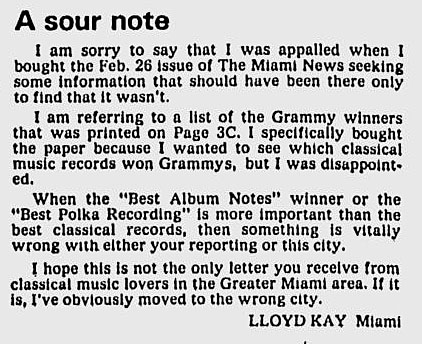
And finally, a letter to the editor from the March 7, 1986 issue of the paper from a very annoyed reader who discovered that he'd moved to the wrong city...but only after he spent 20 cents on a copy of the Miami News.

First a couple of classic Don Wright cartoons.
March 7, 1986

March 11, 1986

And finally, a letter to the editor from the March 7, 1986 issue of the paper from a very annoyed reader who discovered that he'd moved to the wrong city...but only after he spent 20 cents on a copy of the Miami News.
Sunday, March 06, 2011
Almost time to fold up Carlos Alvarez's circus tent

The Herald reports today that according to a Miami Herald/CBS4/Univision 23 poll conducted by Bendixen & Amandi International, "a tidal wave of voter discontent crossing all political and demographic lines threatens to sweep away both Miami-Dade County Mayor Carlos Alvarez and County Commissioner Natacha Seijas from their jobs."
The results of the are fascinating.
But the number that jumps out at me ... or to be more precise, jumps out, waves a red flag and shouts through a bullhorn is 80. Eighty per cent of the poll's respondents couldn't name Carlos Alvarez’s biggest accomplishment in six years as mayor. Nothing. Nada.
From the Herald story:
It represents a sharp turnaround for Alvarez who, in 2007, sought — and got — enhanced power to run the county government, in large part by arguing that a single, empowered executive was needed to fix a dysfunctional county government. Underscoring the last point, when asked to name the strong mayor’s biggest accomplishment, fully 80 percent of poll respondents said there were none or couldn’t think of any.I'm sure the mayor would beg to differ. So maybe the question that should be asked is what has the mayor's communications director, Victoria Mallette been doing?
Isn't it her job to communicate all of the mayor's many accomplishments to the voters?
But all too often we read these kinds of things in the paper: "Mayoral spokeswoman Victoria Mallette did not return calls seeking comment Tuesday." Mallette, it should be noted, makes over $124,000 a year not to return phone calls.
Random Pixels can name one accomplishment. The mayor did fix himself up with a fine ride!
When County Hall's budget ax fell last year, the mayor and commissioners slashed more than $400 million in jobs and spending. Yet one perk was preserved: Their taxpayer-subsidized luxury cars.Now some might say it's petty to focus on somehing like a car lease when you're running a county as large as Miami-Dade. It's just a little thing, after all.
[...]
County Mayor Carlos Alvarez, already provided two county-owned Chevy Suburbans and two drivers to crisscross South Florida, is poised to take possession of a new BMW 550i Gran Turismo sedan. Taxpayers will cover a big chunk of the cost.
But, you see Mr. Mayor, when voters can't name any big accomplishments, they tend to focus on those little things.
Like the song says, "little things mean a lot."
Hit it, Kitty!
Saturday, March 05, 2011
Beepers and pay phones in Casablanca
While doing some research recently, I stumbled upon one of my favorite Miami Herald Tropic magazine articles from 25 years ago. (Remember Tropic magazine?)
"Welcome to Casablanca" by John Dorschner, ran on Sunday, June 15, 1986.
In the piece, written five years after the infamous Time magazine "Paradise Lost" cover story and 3 years after "Scarface" came to town, Dorschner attempted to show how 80's Miami had become, for some, a modern day Casablanca. However, in this remake, Crockett and Tubbs and more than a few Colombian drug dealers, replaced Bogart and Bergman.

Back then, if you knew what to look for, the drug dealers weren't all that hard to spot. They did everything except wear uniforms with name tags.
But the tools of their trade - beepers and pay phones - seem downright quaint today. In some circles, just wearing a beeper meant you might be a drug dealer. (In the 1986 trial of "Miami River cop" Armando Estrada, another officer testified that he had seen Estrada "wearing a beeper.")
In one section of his 1986 Tropic story, Dorschner painted a fascinating picture of the stereotypical 80's drug dealer and drug deal. It's safe to say this is not how drug deals are conducted today.
"Welcome to Casablanca" by John Dorschner, ran on Sunday, June 15, 1986.
In the piece, written five years after the infamous Time magazine "Paradise Lost" cover story and 3 years after "Scarface" came to town, Dorschner attempted to show how 80's Miami had become, for some, a modern day Casablanca. However, in this remake, Crockett and Tubbs and more than a few Colombian drug dealers, replaced Bogart and Bergman.
Look at us now. Awash in crime, still. Aswarm with immigrants. Aboil with fear. And we are . . . Casablanca. They call it exotic intrigue. Romance. Multicultural excitement. This town has become a movie. Or more precisely: a TV show.One of the problems Miami faced 25 years ago was a flourishing drug trade.
You can trace the image back four years, to the time that a television producer named Tony Yerkovich visited Miami. Yerkovich traveled around the town with undercover agents and visited nightspots with "guys on the other side of the law." He heard about dope dealers, gun smugglers, "propagandists for foreign governments," corrupt bank officials, exiled dictators and intelligence agents. Miami, he concluded, was "a modern-day American Casablanca."
Miami-Casablanca : The idea had been floating around since the '60s, mostly cropping up in minor magazine pieces, but Yerkovich was able to convert his vision into truly pop culture. His Miami Vice had banal dialogue and trite plots, but the show achieved a certain look, a feel. Suddenly the show was "hot."
Hordes of out-of-town journalists -- from the London Mail, Sacramento Bee, Paris Match, Dayton Daily News -- have been descending upon Miami, intent upon finding the . . . real story. "There had to be a hundred people doing 'the real Miami Vice,' " says Billy Yout, spokesman for the Miami office of the
Drug Enforcement Administration, who was interviewed by most of them.
When a Norwegian newsman suddenly showed up and asked an undercover Metro agent if he could follow him around for a day, the agent asked if Norway was about to start broadcasting Miami Vice. Yes, said the newsman, how did you know?
Back then, if you knew what to look for, the drug dealers weren't all that hard to spot. They did everything except wear uniforms with name tags.
But the tools of their trade - beepers and pay phones - seem downright quaint today. In some circles, just wearing a beeper meant you might be a drug dealer. (In the 1986 trial of "Miami River cop" Armando Estrada, another officer testified that he had seen Estrada "wearing a beeper.")
In one section of his 1986 Tropic story, Dorschner painted a fascinating picture of the stereotypical 80's drug dealer and drug deal. It's safe to say this is not how drug deals are conducted today.
THE COIN DROPPERS
It's quite easy to see a drug deal happening in South Florida. They're going on all around you, especially if you live in the southern suburbs. All you have to do is know what to look for.
Many dopers still deck themselves out in gold, with the Rolex watch and the Porsche convertible. But others, realizing the stereotypes, are toning themselves down when they go out working.
"Colombians are not overdressed," says Detective Marty Heckman, who -- like Belker on Hill Street Blues -- spends much of his time "hanging out," usually in Kendall shopping centers. "They're suave but not flashy. They like color-coordinated clothes -- if they have gray slacks, they'll have gray shoes. They're all like 5-8, 145-150 . . . beeper on the hip. And they linger by the pay phones, with expensive little black books with all sorts of codified numbers."
The beeper -- usually the digital-readout kind -- is their tool of the trade, such a giveaway that some dopers have started hiding theirs in ankle holsters.
Dope deals are always fluid, perhaps a dozen conversations and meetings, none of which lasts more than five minutes. Doper one beeps doper two to call him at a pay phone. Doper two does so, from another pay phone. Beeper to beeper, pay phone to pay phone, calls virtually impossible to trace. "Coin droppers," detectives like Heckman call them. Men who spend their days hanging around pay phones, usually in Kendall, because that's where most dopers live, and because they often are carrying considerable amounts of cash and they feel more certain they won't run into a random mugger in staid Kendall.
"Miller Square used to be a mecca for them," says Detective Heckman. "At 137th and Miller. But then the uniformed officers started hanging out there in the green and whites, and 'they scared the fish from the bay.' "


Billy Yout at DEA says dopers also like the bank of pay phones beside the Winn-Dixie in the Midway Mall center. Sometimes agents have seen dopers three deep at the phones, waiting for an available line. Dadeland is popular, and the Falls, and gas-station/convenience stores -- any pay phone where there is a large field of view, so that the dopers can check to see if they're being observed.
If you want to spend a little time, you can watch a deal taking place, or at least part of the negotiations. Look for luxury cars -- say, a Mercedes -- parked beside a Kendall pay phone. Or a rental car (rental cars have license-plate numbers beginning with Z), because there's a trend for dopers to seek the anonymity of a bland Oldsmobile rental.
What you see would go something like this scene, witnessed by a journalist on a weekday afternoon:
On Southwest 117th Avenue, a little north of Sunset Drive, a two-tone Lincoln was parked in front of a Farm Store. At a pay phone, a man was dressed casually, in black boots, nondesigner jeans, a loose-fitting Hawaiian shirt. He was wearing a subdued gold-and-steel watch that appeared to be a $1,500 Concord model. He was chatting in a slow, dignified Spanish, using the formal "usted" manner of address.
When the journalist approached and picked up the adjoining pay phone, the man spoke quickly and hung up. A minute later, a beige Mercedes appeared. The Lincoln man walked over and slid into the passenger seat in front.
The Mercedes drove across the street. Three minutes later, it was back, and Mr. Lincoln climbed out, said goodbye to Mr. Mercedes and drove off in his own car.
The "meet" was over.
"That's a perfect profile of a narcotics meet," said Metro narcotics specialist Reddington, when told of the meeting. "That is so common, around any shopping mall in Dade County. More so in the southwest, but it happens all over. . . . It doesn't take a sixth grade education to see that he's not playing the stock market."
Subscribe to:
Posts (Atom)